

Warning: Tree puns in use, but no actual trees were damaged in the writing of this article.
I'm going out on a limb here; I think TuBiShvat is more important to the to the Jewish people than Hanukkah, and I think we do our people a disservice not to emphasize Tu BiShvat in our educational settings. I've said it. Now I'll support it.
I've been a Jewish educator for over 25 years. I've taught a lot of text, the calendar cycle. I was blending the formal and informal before those disciplines were clearly delineated. I've worked in most Jewish youth groups, several camps, day schools, congregational schools and adult learning venues. I consider myself a Zionist. In the context of Hanukkah, I probably more accurately align with a middle-of-the-road, right leaning Hellenist than I do a Maccabee; I've never stabbed or even threatened another Jew who I observed violating Shabbat or Kashrut. Though I may engage in daily prayer and regularly attend synagogue, I do not consider myself a zealot.
Examining the historical record, the kind of victory we celebrate during Hanukkah would likely offend most current progressive or liberal affiliated Jews, yet we know from Pew Research studies and other collected data that Hanukkah is one of our most celebrated holidays. I fear Tu BiShvat, which can be viewed through the lens of having more wholesome and relevant values (appreciating trees, tithing, respecting nature) is largely ignored by a majority of Jews (though due to no lack of effort or energy on the part of our friends at the Jewish National Fund who have spent much of the past 100 years keeping Tu BiShvat part of the consciousness of world Jewry).
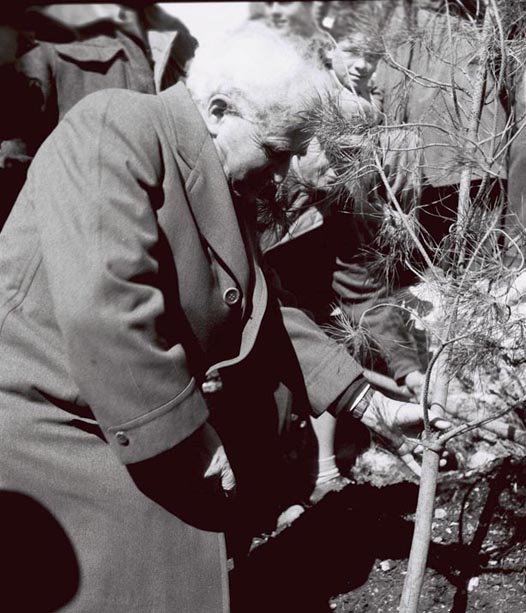
The two black and white photos above are of Prime Minister David Ben Gurion planting trees on Tu BiShvat 5709, February 14, 1949. On his way to open the first Knesset, the first autonomous Jewish government in the Land of Israel since the time of the Maccabees he paused, en route from Tel Aviv to Jerusalem, in what is now the Ben Shemen forest to plant a tree. Except among the 16th Century Kabbalists, Tu BiShvat had been a mostly forgotten observance on the Jewish calendar until it was revived, by a school teacher in Zichron Yaakov, in the early years of the Twentieth Century. Since that time, the idea of reforesting the land, preventing erosion, building reservoirs, adding and preserving green space has been an important part of the Israeli consciousness.
In this time of climate change, how much more so should we celebrate a day that honors trees and planting, while we try to reduce our carbon footprint, eat local, seasonal foods and celebrate the gift that is the Land of Israel, the State of Israel, and generally the life force of our planet Earth. How wise, even if for reasons of economy and taxation the rabbis of the Mishnah set a date on our calendar to standardize the age of the trees in our orchards and forests, allowing us an opportunity for mindfulness - to say a blessing, recognize the gifts of life our planet represents and maybe even plant a tree.
Those of you who know me know about my passion for all things related to Israeli wine. Grape vines are subject to the same planting and taxation requirements that trees are. At (2 of the 3) Tu BiShvat seders I will help facilitate this weekend, Israeli wines will be served and enjoyed.
That tree in the color photo? That's the tree I planted in Be'er Sheva, near the amphitheater in the new River Park, on July 28, 2019 as I began to observe shiva for my mother. Chag Ha'ilanot Sameach!

No comments:
Post a Comment